Prison or Millionaire
A headmaster once made a prediction about Richard Branson. It says less about Branson than about a system that guesses at the one moment that matters most: what comes after school.
When Richard Branson left Stowe School at sixteen, his headmaster Robert Drayson sent him off with one sentence: he would either end up in prison or become a millionaire.
Today that's an anecdote. Back then, it was a verdict. Branson has dyslexia — reading and writing come harder to him than to most. At school, that didn't make him interesting, it made him stand out. He was someone who didn't fit the grid, someone for whom there was no useful metric. So the system reached for the only category left: risk.
The teenager once predicted to end up in prison became the founder of one of the world's best-known business empires. And for decades, Branson has used his reach to speak up for people who were told early on that they weren't enough.
What's remarkable about this story isn't that the headmaster was wrong. What's remarkable is that the school made a prediction at all, despite knowing nothing about the traits that actually mattered. It had grades. It had no instrument to capture how this student thinks, decides, and works.
The most expensive moment in an education
Nowhere does this gap weigh more heavily than at the threshold after graduation. Within a few months, a decision gets made that shapes the years ahead, and it gets made on a surprisingly thin foundation.
On one side stands an offering that's barely possible to survey. The platform studium.at alone lists over 2,700 degree programmes in Austria. On the other side stand school grades, maybe an internship, an open day, and the assessments of well-meaning people who rarely know more than the students themselves.
What follows from that is well documented.
Of first-year students in a cohort tracked by Statistics Austria over ten years, 27.2 percent left their degree without graduating. Nearly one in three study decisions, in other words, doesn't lead where it should.
At the same time, a substantial share of an age group sits entirely outside the system: in Austria, 121,930 people between 15 and 24 were recently neither in education, nor employed, nor in an AMS training programme, 12.9 percent of that age group.
And which path someone takes still depends heavily on where they come from. Among 25- to 44-year-olds whose parents have at most a compulsory-school education, 9.4 percent themselves reach a higher-education degree. Among children of university graduates, it's 61.3 percent.
None of these numbers measure talent. They measure how reliably background, chance, and poor fit decide who gets to use their potential, and who doesn't.
Why it goes wrong for the strongest students
There's a common assumption that guidance is mainly needed by those who struggle. For cognitively high-performing students, the opposite is often true.
Someone who's good at many things doesn't have a selection problem of too few options, but of too many plausible ones. Law, medicine, computer science, business, all of it would work, and that's exactly what makes the decision hard instead of easy. Classic orientation tools offer little help here, because they're built to distinguish between broad interest directions. When several directions score highly at once, the method produces a list instead of a basis for deciding.
There's a second pattern on top of that: someone who gets good grades at school without much effort never develops a way of working, because they never needed one. The break comes in the first semester, once external structure falls away. The grades of the previous years gave no warning, because they measured the wrong thing.
What a better foundation has to deliver
Cebras grew out of the Mensa community and works at the upper end of the ability distribution. In study orientation, that means concretely: not asking what someone is interested in and deriving a list of careers from it, but capturing the traits that actually determine fit.
That includes cognitive ability and its profile, not just how strong, but in which direction. It includes interest structure, working style, and values, because a degree has to fit not only in content but in its way of working. And it includes the question of under which conditions someone performs, and under which they don't. Cebras combines established psychological instruments for this and evaluates them together, rather than leaving each result to stand on its own.
The process runs entirely online. That's not a technical detail, it's the reason it works independent of where someone lives and what their calendar looks like. A personal conversation about the results is possible, but it's an addition, not a prerequisite.
Two things matter here, because they're often conflated. The result is not a prediction. It doesn't forecast who will succeed. And it's not a label. A label closes a question; a foundation makes the next decision better.
Why Richard Branson is an honorary member
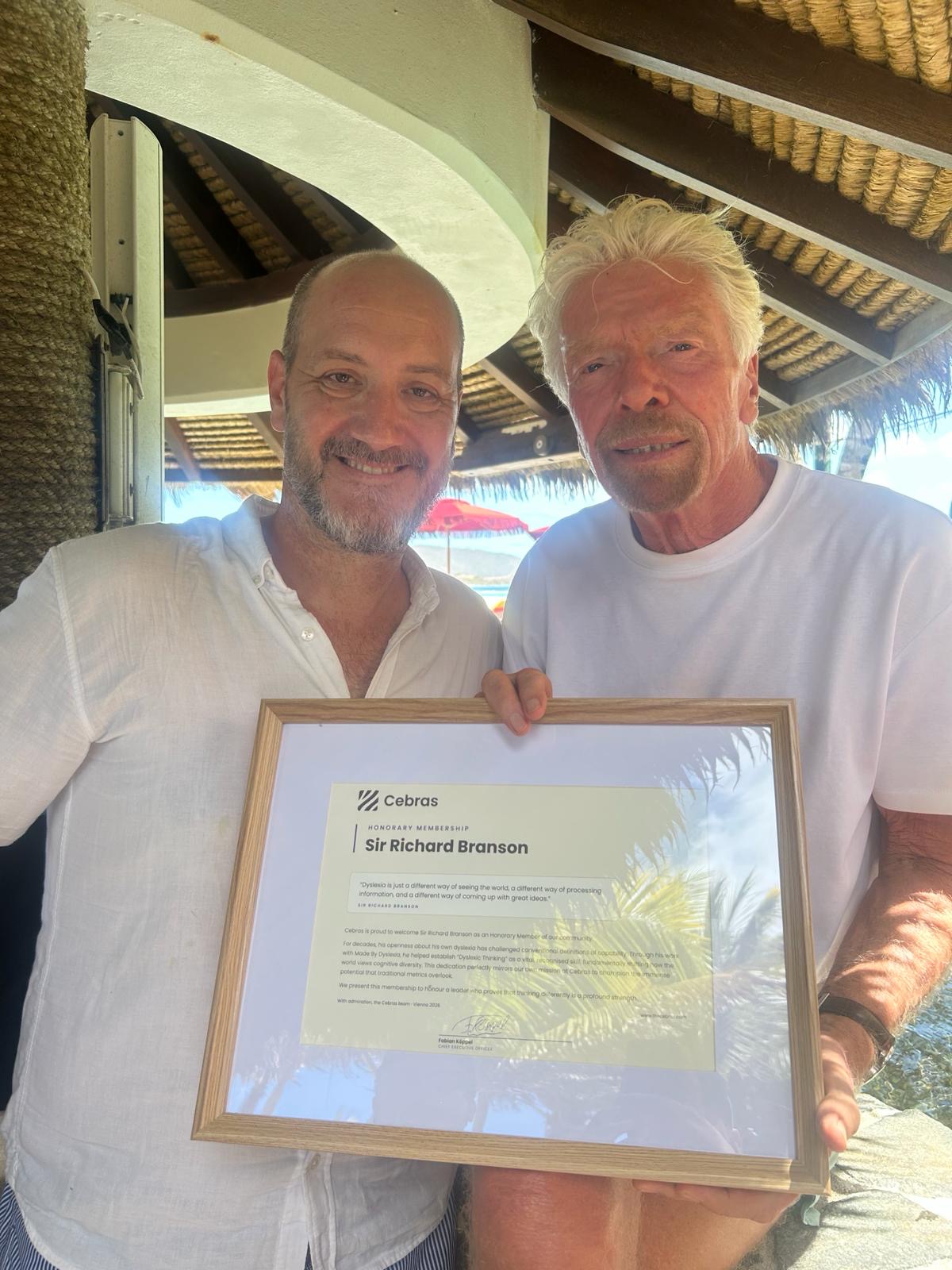
Cebras appointed Richard Branson as an honorary member. Co-founder Benedikt Rettenbacher presented him with the honorary membership in person on Necker Island.
The reason isn't the business empire. The reason is that Branson has spent decades publicly standing up for people whose abilities show up in no report card. His story shouldn't remain the exception people tell because it's so rare. It should be the starting point.
Because the goal isn't to celebrate the few who prevailed against the system. The goal is that the next generation no longer has to prevail, because they know from the start what they're working with.
Most people never find out what they're actually capable of. For a decision that determines as much as the one after graduation, that's too late.
Sources
- Programme offering: studium.at, number of degree programmes listed in Austria.
- Dropout rate: Statistics Austria, "Bildung in Zahlen 2023/24," cohort of first-year students from winter semester 2013/14, tracked over ten years.
- NEET figures: Statistics Austria, "NEETs im Wandel. Zahlen, Daten und Entwicklungen 2009 bis 2023."
- Educational inheritance: Statistics Austria, Adult Education Survey 2022/23.
- Biographical details on Richard Branson: publicly documented, Stowe School, headmaster Robert Drayson.